
Aiken County Arrest Warrants Explained
In Aiken County, an arrest warrant begins with a sworn request. South Carolina law says an officer must seek it in an official capacity. The officer lays out facts amounting to probable cause. A magistrate or judge with authority then reviews those grounds before process issues. The finished warrant directs a peace officer with jurisdiction to make the arrest. A summary-court warrant can also serve as the charging paper in a criminal case, and a felony may move on to General Sessions after preliminary process. The court, not the Sheriff's Office, decides what the order says and what bond or hearing terms apply.
Aiken County Arrest Warrants Need Probable Cause
Section 22-5-110 governs the front end of an Aiken County arrest warrant. No warrant may issue unless a law-enforcement officer requests one in an official capacity. The magistrate examines the grounds before signing anything. That is a legal threshold, not a public status-search form. For a particular case, ask the issuing court which public record names the charge and the next appearance. Keep in mind that an affidavit or a sealed part of the file may stay out of public view.
Aiken County Magistrates Issue Arrest Warrants
Aiken County magistrates hear minor criminal matters, set bail, conduct preliminary hearings, and issue arrest and search warrants within their authority. The county magistrate directory lists the local summary-court offices. Municipal judges hold similar criminal powers inside their own cities. Felonies take a different road. Those cases run through the Circuit Court's Court of General Sessions, with support from the Aiken County Clerk of Court. For the statutory framework, South Carolina Code section 22-5-110 lays out the officer-request and magistrate-examination process a warrant must pass.
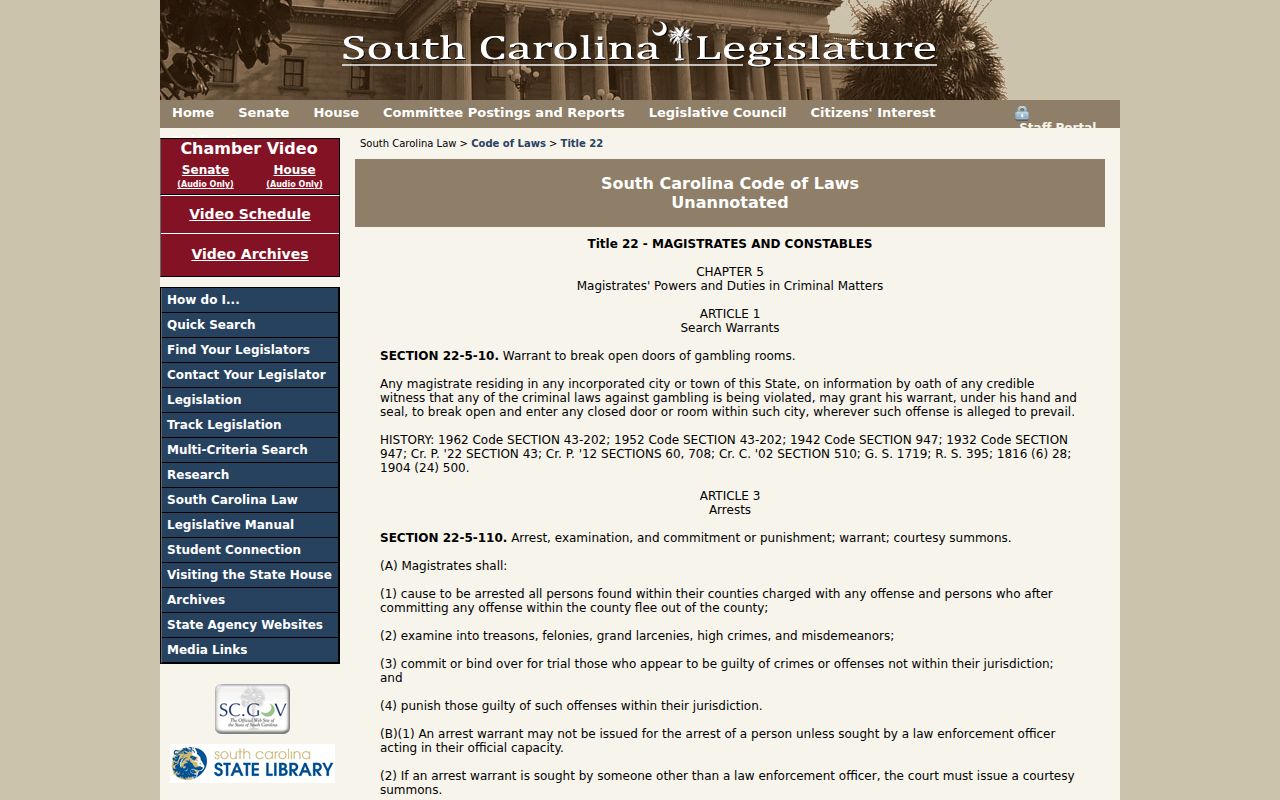
The statute explains how an Aiken County warrant is issued, not whether a particular one is still active today.
Inside an Aiken County Arrest Warrant
Public Aiken County records can carry identifying fields, but no single Aiken form or number format applies across every office. Some entries show a name and a charge. Others carry a case number. The Aiken Trial Court Public Index can help locate a trial-court case, though it is not a complete active-warrant search. Sealed material and protected details may not appear online at all.
| Case or warrant number | Identifier, if the court or agency makes it public; no local format was documented. |
|---|---|
| Case caption | Caption may identify the defendant and case; private names are not reproduced here. |
| Charge or offense | Charge and statute or classification, when disclosed. |
| Issuing court | Magistrate, municipal judge, or court process shown on the public record. |
| Bond and conditions | May state an amount, type, or no-bond condition when public. |
| Issue and service | Date, serving agency, or return information, if available. |
Aiken County Warrants Have Separate Service Routes
Service in Aiken County runs through more than one door. The Sheriff keeps a Warrants Team inside Special Operations. Aiken and North Augusta each run their own public-safety departments. Smaller municipalities may rely on local police with county dispatch backing. The Sheriff dispatches Burnettown, Jackson, New Ellenton, Perry, and Wagener police. That coordination does not turn each city's court record into a county warrant record, so confirm issuance with the court named on the charging paper and ask the serving agency about service. The Sheriff's division directory lists the Warrants Team under Special Operations.
Serving Arrest Warrants in Aiken County
An Aiken County warrant is directed to a peace officer with authority in the county. Who serves it varies. Depending on the issuing court and the location, the job may fall to the Aiken County Sheriff, city police, SLED, or a regional or federal task force. Aiken County Communications coordinates calls for several departments. The court still controls recall and case settings. After an arrest, the person is booked and moved through bond or magistration steps. Aiken Bond Court sits at the Detention Center. The serving officer has no say in whether the underlying case is dismissed or the warrant is recalled.
Aiken County Bond Court After Arrest
The county directory lists Bond Court at 435 Wire Road, phone 803-642-2044. Weekend and holiday hearings run at 10 a.m. and 1:30 p.m. Those are set hearing times. They promise no walk-in surrender or immediate release. Call ahead, or have counsel confirm the process. A judge sets the bond and its terms. The Sheriff does not pick the amount. A bond receipt does not dispose of the charge, so verify the next court date and any conditions with the clerk, your attorney, or a bondsman.
Comparing Arrest, Summons, and Bench Warrants
Aiken County courts work with three tools. An arrest warrant allows custody once probable cause supports it, while a summons simply tells a person to appear. A bench warrant is different. It answers a missed court date or another obligation in a case already open. South Carolina's statute also allows courtesy summonses in some matters.
| Feature | Arrest Warrant | Summons | Bench Warrant |
|---|---|---|---|
| What It Orders | Arrest under the order | Appear at the stated date or place | Arrest or appearance after court noncompliance |
| Basis | Officer's probable-cause showing | Charging or notice process | Missed court duty or order |
| Who Issues It | Magistrate or authorized judge | Court process, as authorized | Judge in the pending case |
| How to Respond | Confirm court and seek counsel | Attend as directed | Contact the issuing court about recall |
Aiken County Federal Process Is a Separate Layer
Federal process sits outside the usual Aiken County court chain. The U.S. District Court for South Carolina and the U.S. Marshals Service handle it. The Carolinas Regional Fugitive Task Force joins federal and local agencies, and the Aiken County Sheriff takes part. That cooperation is not a county warrant roundup, though, and no public search list comes from it. For a federal matter, turn to the federal clerk or PACER for docket research, and ask counsel about sealed records. The county Public Index and state traffic results cannot establish federal warrant status.
If There's an Arrest Warrant for You
Start by confirming which court issued the warrant, the case number, and the agency that serves it in Aiken County. A search result will not settle that. It may not show a bond amount either. Before you walk in, ask a South Carolina attorney whether a hearing, a motion, a voluntary surrender, or preparation for bond fits your situation. If no lawyer is reachable, call the issuing court for its public instructions. Get any answer in writing. The line between an arrest process and a bench warrant matters, since Aiken County courts may demand a different filing or appearance for each. Posting bond addresses release only, not the merits of the charge.
Important: Ask counsel about surrender and bond before appearing; an officer may serve an active arrest warrant during ordinary contact.